
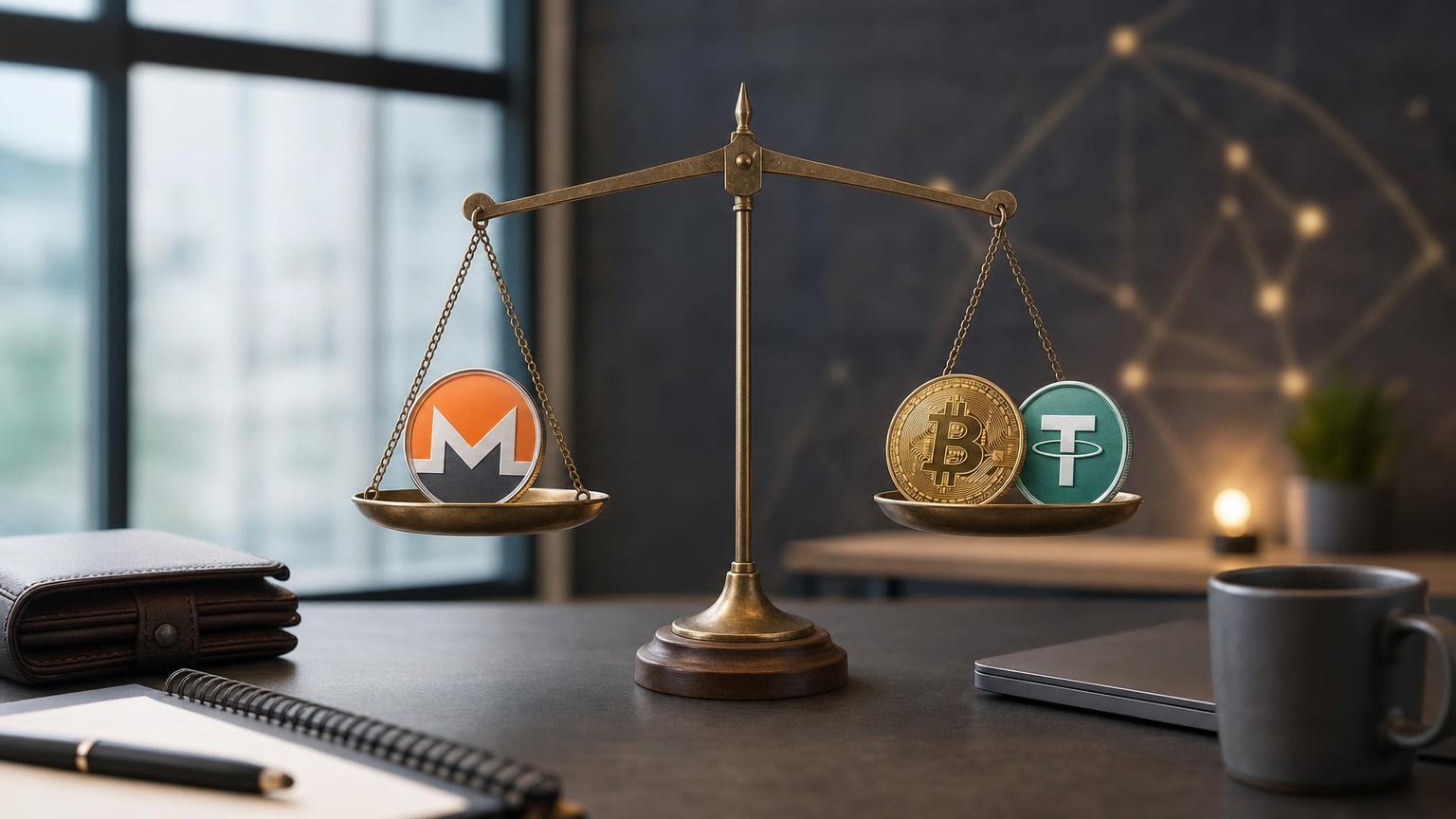
Short conclusion: XMR to BTC is generally the more direct route when the intended result is exposure to Bitcoin or a payment from a Bitcoin wallet. XMR to USDT is generally easier to evaluate in US-dollar terms, but it introduces an issuer-backed token and requires an explicit choice of blockchain network. Neither direction is inherently cheaper, faster, more private, or more suitable in every case. The defensible comparison is based on the exact amount receivable, the destination network, subsequent use of the asset, and the conditions displayed for the specific order.
How the claims were checked
Protocol-level statements were matched to documentation maintained by the Monero and Bitcoin projects. Claims about USDT’s structure, supported protocols, backing model, and redemption conditions were checked against Tether’s official documentation and legal terms. Source dates were used where the publisher displayed them; an undated page is identified as such rather than assigned an estimated publication date. Freshness was assessed against the information available on September 7, 2026.
Live exchange rates, order limits, network charges, pair availability, and compliance requirements cannot be established from protocol documentation. They must be checked in the transaction interface when an order is created. A historical fee or quotation would not prove which route is preferable for a later transaction.
Confirmed facts that affect the comparison
Monero is designed to conceal transaction origins, destinations, and amounts through ring signatures, stealth addresses, and RingCT. Its official documentation contrasts this model with transparent blockchains such as Bitcoin. [1]
That privacy does not automatically continue after an exchange. Bitcoin uses a public ledger containing an ordered record of transactions, while individual transactions reference previous outputs and create new outputs with visible amounts. Reusing addresses can make transaction relationships easier to follow. [2]
USDT differs from both XMR and BTC because it is a token issued on multiple blockchain protocols. Tether instructs users and integrators to identify the supported protocol explicitly and warns that the destination must use the correct transport protocol. Therefore, “USDT address” alone is incomplete information: the sender and recipient must also agree on the network. [3]
USDT is designed to be pegged one-to-one to the US dollar and is backed by assets held in Tether’s reserves, according to the issuer. It is not fiat currency, legal tender, a bank deposit, or government-insured money. Direct issuance and redemption through Tether are contractual services subject to eligibility, verification, fees, minimums, legal restrictions, and possible suspension under the issuer’s terms. [4]
These facts create the central distinction. After XMR to BTC, the user holds the native asset of the Bitcoin network and remains exposed to BTC’s market price. After XMR to USDT, the user holds a dollar-referenced token whose practical operation depends on both the issuer framework and the selected host blockchain.
Claims register
| Claim | Confirmation status | Primary source type and name | Publication or update date | Limitation | What could change the conclusion |
|---|---|---|---|---|---|
| Receiving BTC does not preserve Monero’s on-chain privacy model. | Confirmed at protocol level | Official project documentation: Monero Moneropedia and Bitcoin Developer Guide | No update date displayed on the cited pages | This describes ledger design, not the complete ability of a third party to identify a particular person. | Wallet practices, address reuse, exchange records, disclosure of ownership, and future protocol changes can affect practical traceability. [5] |
| USDT requires a network-specific receiving address and matching protocol support. | Confirmed, but the list of supported protocols is dynamic | Issuer documentation: Tether Supported Protocols and FAQ | No update date displayed on the protocol page | Tether’s list does not prove that a particular exchanger, wallet, or recipient supports every listed network. | A platform may add, suspend, or remove a USDT network; Tether may also change protocol support. [3] |
| USDT provides dollar-referenced denomination without being equivalent to dollars in a bank account. | Confirmed as the issuer’s product and legal structure | Issuer legal document: Tether Token Terms of Sale and Service | Updated February 26, 2026 | A one-to-one issuance or redemption term does not guarantee that every secondary-market trade occurs at exactly one US dollar. | Changes to reserve composition, legal terms, eligibility, redemption access, market conditions, or applicable law could alter the practical comparison. [6] |
| XMR to USDT is cheaper than XMR to BTC. | Unknown until a live quotation is available | Primary transaction record: order interface and terms for the selected direction | At the time the order is created | Protocol documents do not establish an exchanger’s rate, spread, included fees, minimum amount, or destination-network charge. | A different quote, amount, network, congestion level, fee policy, or later transfer requirement can reverse the result. |
| One route will complete faster. | Dependent on conditions | Primary operational records: order status, source-chain transaction, and destination-chain explorer | Generated during the transaction | Completion includes several stages: XMR deposit detection, required confirmations, processing, and destination settlement. | Network conditions, confirmation policy, wallet maintenance, compliance review, or an incorrect deposit can materially extend completion. |
| A specific XMR/BTC or XMR/USDT direction and a particular destination network are currently available. | Unknown until checked | Primary service record: current order-creation interface | At the time of the attempted order | Support for XMR, BTC, and USDT does not prove that every pair, direction, or USDT network is active. | Liquidity, maintenance, compliance policy, network availability, and operational changes may affect access. |
How to compare the routes in practical terms
Start with the purpose of the destination asset. If BTC will be sent to a Bitcoin address, held in a Bitcoin wallet, or used in a BTC-denominated transaction, converting to USDT first may add another conversion later. If the intended amount is defined in US-dollar terms, USDT can make that amount easier to read, although the issuer, network, and market limitations still apply.
Compare the amount actually received
Do not compare only the headline XMR/BTC and XMR/USDT rates because their units are different. Record both quotations at nearly the same time, then convert the outputs into one neutral reference unit using the same external market snapshot. A useful calculation is:
Comparable output value = quoted destination amount × reference value of the destination asset − charges paid outside the quote.
This is a calculation method, not a prediction. It should include only costs that are known for the specific operation. If the quoted output already incorporates the exchange charge, subtracting that charge again would distort the comparison.
For example, suppose a user intends to move the result to another wallet immediately. The route showing the larger value at the exchange stage may become less efficient after the destination withdrawal or transfer cost is included. Because USDT exists on several networks, its transfer cost cannot be assessed until the exact network is known. BTC transfer conditions are likewise dynamic and should be checked rather than assumed from an earlier transaction.
Count the next step, not only the exchange
- For long-term BTC custody: compare direct XMR to BTC with the total cost and operational risk of XMR to USDT followed by USDT to BTC.
- For a USDT payment: confirm the recipient’s exact network before creating the order. The network name shown by the sender, exchanger, wallet, and recipient must match.
- For later trading: check which destination asset and network the next platform accepts. A nominally attractive route is not useful if another conversion or bridge is required.
- For accounting in dollar terms: USDT offers a dollar-referenced unit, but records should still distinguish the token from fiat cash and identify its blockchain.
Account for compliance conditions
An XMR deposit may be private on-chain, but an exchanger can still associate the deposit, order, destination address, account information, and compliance records. The level of verification may depend on the direction, transaction details, and results of compliance checks. Current requirements should therefore be reviewed before an order is created. Rules also differ across countries, and a technically valid transaction may still be restricted by a platform’s terms or local law.
Risks and a repeatable pre-transaction check
Volatility: BTC’s value can move while an order is being processed. USDT is intended to track the US dollar, but it carries secondary-market, issuer, reserve, legal, and redemption-access risks. Neither outcome should be treated as a guaranteed store of value.
Wrong network or address: this risk is especially visible with USDT because the same ticker appears on multiple blockchains. Confirm the asset, network, full address, and any required memo or tag. For BTC and XMR, verify that the destination is an address for the correct asset. A valid-looking address is not proof that it belongs to the intended recipient.
Irreversibility: blockchain transfers generally cannot be cancelled after valid broadcast and confirmation. Copy-and-paste malware, address substitution, and phishing pages can redirect funds, so compare the first and last characters and, where possible, verify the address through a second trusted channel.
Privacy boundary: converting from XMR to a transparent destination chain changes what can be observed on-chain. Splitting funds across addresses does not by itself guarantee anonymity, particularly when the exchange or another service can connect the transactions through internal records.
Immediately before creating an order, repeat the following checks:
- Confirm that the required direction is active for the intended amount.
- For USDT, confirm the exact blockchain at both the exchanger and receiving wallet.
- Record the quoted output and whether network or service charges are included.
- Check the minimum, maximum, rate-validity rules, and required confirmations shown for that order.
- Review the applicable verification and compliance conditions.
- Recheck the destination address after pasting it and before authorising the transfer.
- Save the order identifier and transaction hashes without exposing private keys or recovery phrases.
Once the intended asset, receiving wallet, and destination network are known, check the currently available XMR exchange directions and order conditions. This operational check is not evidence that one route is universally preferable; it supplies the live details needed to apply the comparison above.